Somewhere in India right now, a car owner is standing in a parking lot, tilting their head, trying to convince themselves that the strange texture on their bonnet is just a trick of the light.
It isn’t a trick of the light. It’s a botched PPF installation that nobody told them to watch out for.
The uncomfortable truth about the PPF industry is that the barrier to entry for a shop to call itself a “PPF installer” is almost zero. Anyone can buy a roll of film, watch a few videos, and start taking customers. This doesn’t mean every budget shop is incompetent, but it does mean there’s an enormous quality spectrum, and most customers have no idea where on that spectrum their installation lands until something goes visibly wrong.
Here’s what wrong actually looks like and how to spot it before the damage becomes irreversible.
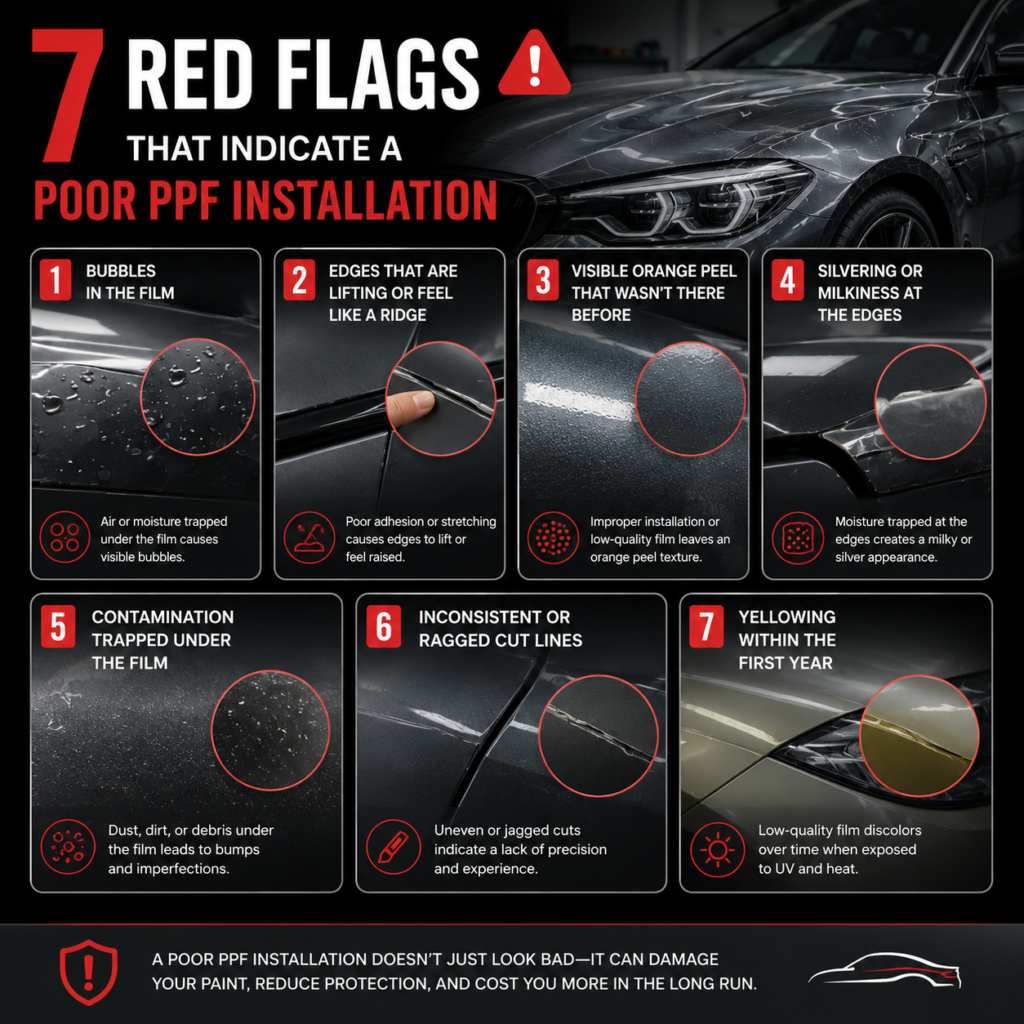
1. Bubbles in the Film
Let’s start with the most common confusion point first. Water bubbles that appear immediately after installation are completely normal; they occur because the adhesive is still hydrating and will disappear within 24 to 48 hours as the film cures. A good installer will tell you this before you even ask.
What you should not see are air bubbles: larger, hollow pockets that don’t shift when pressed and don’t disappear after a few days. Air bubbles indicate that the film was applied over contaminated paint, that the surface wasn’t properly prepared, or that the technician’s squeegee technique wasn’t adequate. None of these issues self-correct. They get worse.
2. Edges That Are Lifting or Feel Like a Ridge
Take your fingertip and slowly run it along every panel edge where the film meets exposed paint: the bumper lip, the bonnet corners, the mirror caps. On a properly installed film, you should feel nothing at all. The film should be tucked or wrapped so cleanly that the transition is physically imperceptible.
A ridge, a raised lip, or a corner that’s already peeling away is not minor. Lifted edges act like a funnel for everything the road throws at your car: dust, moisture, grime, insects. What starts as 2mm of lift becomes a 10cm peel within a few months, and the adhesive residue that gets left on your paint during removal is its own problem entirely.
3. Visible Orange Peel That Wasn’t There Before
Your factory paintwork has a very faint orange peel texture; this is inherent to the spray painting process and varies by manufacturer. But if you’re suddenly seeing a pronounced, lumpy texture after film application that wasn’t visible before, the film wasn’t heat-formed and squeegeed correctly. A quality installation is optically transparent. You should look at the panel and see your paint, not the film.
4. Silvering or Milkiness at the Edges
In direct sunlight, look at the border areas of the film at a shallow angle. A correct installation shows nothing; the edges are invisible. A whitish, milky, or silvery haze along the film borders is adhesive contamination, caused when the installation technique disturbs the adhesive layer during edge tucking or trimming. It is permanent. It does not clear up.
5. Contamination Trapped Under the Film
Stand your car under bright, raking light and look carefully across the panel surface. You’re checking for dots, specks, or small bumps sitting under the film surface. These are particles, usually dust or debris, that weren’t removed during surface preparation. The industry accepts a small number of very fine particles (the size of a grain of sand) as unavoidable. What is not acceptable is visible contamination spread across a panel, particularly on the bonnet where environmental exposure during installation is highest.
Whatever is under the film on day one is under the film for its entire lifespan. There is no way to fix this without removing and replacing the affected panel’s film.
6. Inconsistent or Ragged Cut Lines
Every PPF installation has cut lines at the places where the film is trimmed to meet a panel edge, a door shut, or another piece of film. These are acceptable and expected. What they shouldn’t be is jagged, inconsistent, or placed across the middle of a visible panel with no logical reason.
Compare the cut line position on the left front fender with the right front fender. They should be mirrored. If one is sitting 3mm from the edge and the other is 12mm from the same edge, that’s a process problem, and it usually signals the same lack of attention was applied everywhere else on the car.
7. Yellowing Within the First Year
Premium thermoplastic polyurethane (TPU) film, the type used in quality installations, should remain optically clear for years. Yellowing within the first year of installation is almost always a sign that a lower-grade or PVC-based film was used, regardless of whatever brand name was mentioned in the quote. PVC films are cheaper to purchase, much easier to install, and significantly quicker to fail. They also carry a much higher risk of damaging paint on removal.
If your film is yellowing early, ask for the exact product name and cross-reference it with the manufacturer’s website. If the shop can’t provide that information, you have your answer.
None of these red flags are minor inconveniences. A poor installation on a ₹20–50 lakh car is a real financial problem both because of the cost of remediation and because film removal from a car with poor installation dramatically increases the risk of paint damage.
The right time to identify these problems is before you accept delivery, in good light, with your installer present. If you’re looking at a car and ticking multiple boxes on this list, don’t sign off. Any installer who stands behind their work will have no objection to fixing what’s wrong before the car leaves.
At Prime Car Care, every car goes through a final quality inspection before delivery, walked through with the client. If you’re unsure about an existing installation, bring the car in for a complimentary inspection. primecarcare.in/contact